

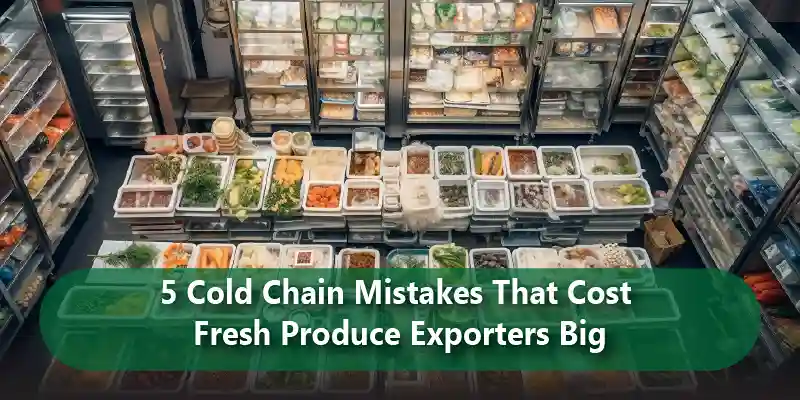
5 Cold Chain Mistakes That Cost Fresh Produce Exporters Big
The global fresh produce industry has never been more competitive. Consumers want strawberries that taste like they were picked seconds ago, leafy greens that stay crisp for days, and tropical fruits that survive long transit without softening. To achieve this, exporters rely on an invisible backbone that keeps every tomato, berry, avocado, and grape in perfect condition. That backbone is the cold chain.
Yet every year, exporters lose millions because this cold chain is mishandled. Tiny operational errors grow into large scale financial losses. A single temperature slip during shipping can destroy half a container. A delay in pre-cooling can trigger mold growth. Poor handling during customs can ruin an entire season’s revenue. These failures are what experts call cold chain mistakes, and avoiding them separates successful agricultural brands from those struggling to remain profitable.
Below are the five most damaging mistakes that silently drain money from fresh produce exporters around the world.
1. Improper Pre-Cooling Before Shipping
Pre-cooling is the foundation of produce preservation. The moment fruits and vegetables are harvested, they begin a natural respiration cycle. If they are not cooled immediately, they lose moisture, soften, and begin to decay long before reaching international buyers.
Many exporters underestimate the importance of this first step. They move produce from farms directly to trucks without controlled cooling. This single oversight creates early damage that later transforms into large scale fresh produce export losses.
Pre-cooling is the stage that stabilizes internal temperature. When it is skipped or rushed, exporters face reduced shelf life, fungal growth, surface damage, and customer rejection claims. The entire future journey of produce depends on this one moment of temperature control.
2. Relying on Low Quality or Incorrect Cold Storage Facilities
Not all cold rooms are created equal. Some facilities lack humidity control. Others have uneven air circulation. In many cases, exporters use cold rooms designed for frozen meat or bulk grains rather than temperature sensitive produce.
This is one of the most common cold storage errors. Fruits and vegetables each require precise temperature and humidity ranges. Grapes demand a different environment than mangoes. Leafy greens wilt if humidity is wrong. Strawberries sweat if temperature fluctuates.
When exporters store goods in general purpose cold rooms instead of produce specific facilities, the result is significant fresh produce export losses that are avoidable. Storage is not just about being cold. It is about being correct.
3. Poor Temperature Management During Transit
Cold chain success depends on motion. Temperature is not only maintained inside a warehouse. It must be protected through every kilometer of transport. Trucks, ships, and planes are where exporters lose the most money without realizing it.
Poor calibration of transport units, inconsistent door opening practices, or reliance on non refrigerated containers create massive failures in supply chain temperature control. The worst part is that transit damage is often invisible until the product reaches its destination. Exporters discover the issue too late, when customers open the shipment and find soft, spoiled, or discolored products.
With modern technology, exporting companies should install real time temperature sensors that alert them instantly when there is deviation. Without this visibility, cold chain transport becomes a gamble each time a shipment moves.
4. Lack of Coordination Between Stakeholders
The cold chain is only as strong as the level of communication within it. Farmers work separately. Transporters operate as if they are the middle link. Packaging teams focus on their own tasks. Export managers worry only about paperwork. Buyers wait without real time updates.
This disconnection is one of the deepest cold chain mistakes because fresh fruit and vegetables travel through a shared ecosystem. If one party fails to notify another about delays, power outages, or stock readiness, spoilage begins.
Successful exporters create synchronized cold chain networks where every movement is shared digitally. They use software that tracks produce at every stage. They maintain trained teams instead of fragmented responsibilities. Unity is what protects freshness.
5. Treating Packaging as an Afterthought Instead of a Scientific Requirement
Packaging is not decoration. It is science. Some exporters believe that produce only needs crates or boxes. However, the wrong packaging traps heat, blocks ventilation, encourages ripening, and accelerates breakdown.
Correct packaging supports supply chain temperature control by allowing air to circulate while protecting delicate skin from pressure damage. Ventilated containers, humidity controlled liners, modified atmosphere bags, and breathable fiber trays all increase shelf life dramatically.
Ignoring packaging is one of the quiet causes of fresh produce export losses that many exporters never identify. The easiest way to save millions is often to upgrade packaging materials and standards.
Why These Mistakes Hurt More in Today’s Market
The modern buyer is unforgiving. Supermarkets measure freshness in hours, not days. Hotels demand crispness and aroma from every ingredient. Consumers publicly rate produce if it arrives bruised or wilted.
If exporters repeat historical cold chain Logistics mistakes, they lose credibility, contract renewals, and market expansion. Today’s world belongs to companies that treat freshness as a technology driven process, not a matter of chance.
Cold chain success is not a single point. It is a continuous line that never breaks.
How Smart Exporters Win in the Future
Leading agricultural exporters are transforming their operations through:
- Digital monitoring of every shipment
- Investment in specialized cold storage facilities
- Training staff in handling and temperature response
- Partnering with logistics companies that offer accuracy guarantees
- Making packaging a scientific decision
- Using AI powered forecasting to avoid stock build up
- Planning alternative transportation when delays strike
- Inspecting produce at every stage, not only before departure
Success begins when exporters treat the cold chain as a living, breathing ecosystem instead of a mechanical step.
The Business Cost You Cannot Ignore
Exporters who manage cold chain correctly enjoy:
- Longer produce life
- Higher selling price
- Lower waste levels
- Faster market acceptance
- Customer loyalty and recurring contracts
- Better global brand reputation
Those who do not invest continue to face fresh produce export losses and unstable business futures.
The choice is simple. Control temperature or watch profit melt away.
Turn Freshness Into Profit
At Fresh Load International, we safeguard every degree of freshness from farm to final delivery.
We do not guess. We measure. We monitor. We protect.
Whether you export grapes from India, berries from Kenya, leafy greens from Jordan, or tropical fruits from Africa, your produce deserves a journey engineered for perfection.
Partner with a team that understands cold chain science, values precision, and delivers freshness that earns trust across global markets.
Contact us +971 54 751 5179 today at the Fresh Load International. Where temperature becomes strategy and every shipment arrives ready to impress.